The Mid-Market Breaking Point
Labor is easily the biggest and most volatile expense on your books. If you are a mid-market operator scaling from 40 to 150 employees, you already know this is the exact stage where things start to break. Revenue might be climbing steadily, but severe back-office friction is quietly eating your margins.
Whether you are in civil infrastructure, MEP contracting, home healthcare, or property maintenance, the core operational failure looks exactly the same. Your field operations are outgrowing your administrative capabilities. When crews doing things differently becomes the norm, you quickly realize that manual review doesn’t scale.
The Uncomfortable Truth About Your Workflow
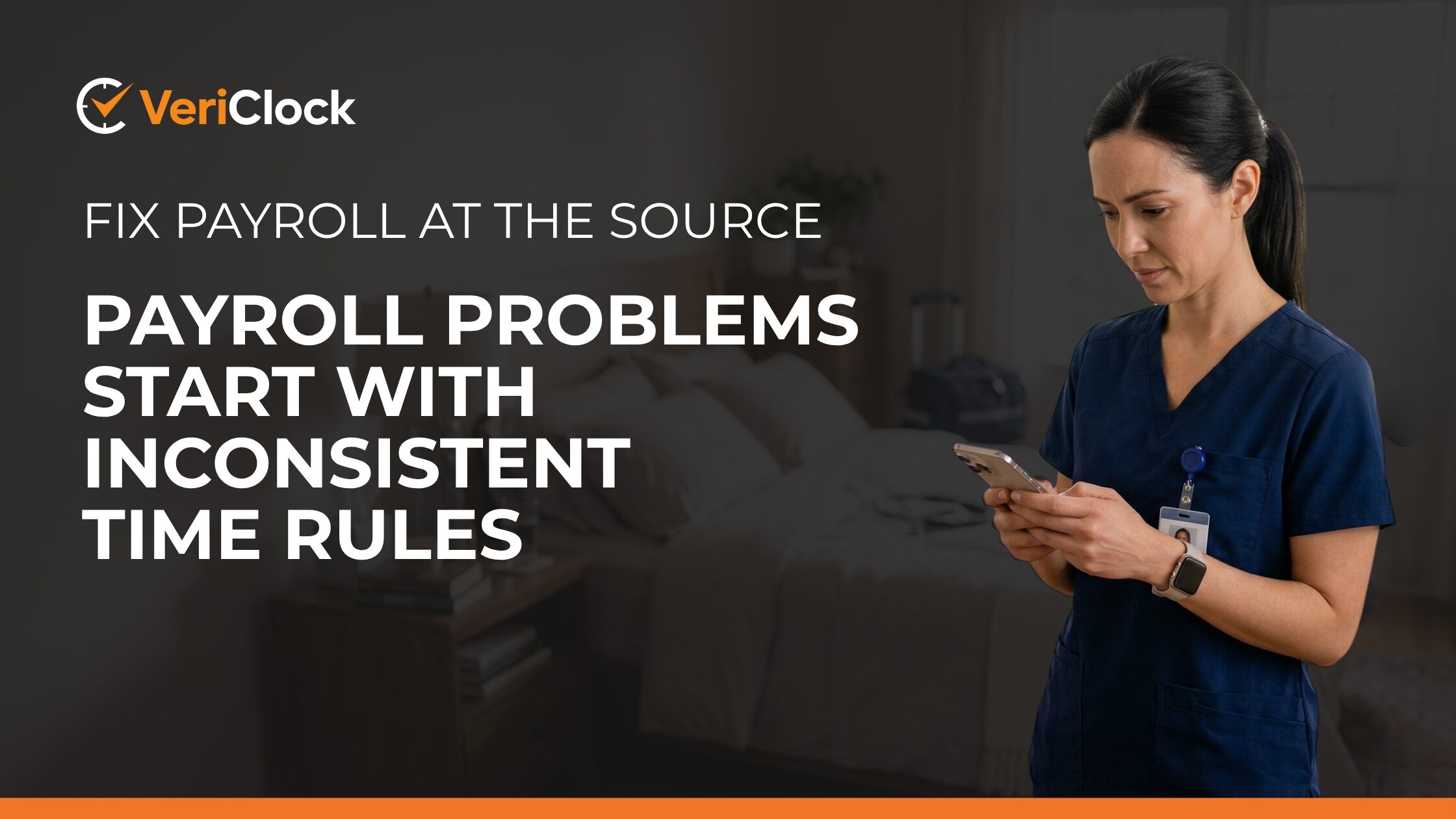
Let’s start with a harsh reality. If your payroll team is fixing time inside your ERP, your system is already broken. If time needs to be corrected after it gets exported, you have already lost control.
Most mid-market contractors are currently trapped in a deeply flawed workflow. They export time data from the field, spot the inevitable errors, fix them by hand, and then try to re-export.
Time is captured inconsistently across various crews, pushed into the accounting system, and then corrected after the fact. This is exactly where your operations break down. Inconsistent inputs create inconsistent payroll. Time data has to be fully structured before you export it, not corrected afterward.
This is exactly the problem VeriClock was designed to solve. Instead of correcting payroll after the fact, VeriClock enforces structured time capture and approval workflows before data ever reaches your ERP.
The High Cost of the “Mini-Company” Problem
This lack of standardization is actively destroying your bottom line. Inconsistent rules per crew lead directly to severe payroll inconsistencies and deep manager confusion.
When you scale your headcount, relying on individual oversight immediately fails. If you have ten different foremen enforcing their own unwritten rules, you are effectively running ten different mini-companies. Profit leaks happen the moment institutional knowledge replaces hard system logic.
According to workforce research from organizations like the American Payroll Association and construction finance groups such as the Construction Financial Management Association, operational errors and inconsistent time capture can materially impact payroll accuracy. You end up paying for hours that were never actually worked, and your payroll team spends days chasing down supervisors for clarifications.
The financial bleeding gets worse when you add multiple locations, specialized departments, and strict compliance rules. One crew might operate under rigid prevailing wage requirements, while another handles standard commercial property maintenance. Crossing state lines or dealing with distinct union overtime triggers creates immediate and severe audit risks.
Research from the CFMA shows that standardizing these exact labor inputs is mandatory for protecting profit margins and surviving compliance audits. You cannot rely on a supervisor’s memory to navigate complex labor laws. You need proactive, structural financial control.
Operational Proof: What Enforcement Actually Looks Like
Here is what an enforced system looks like in practice. Achieving real operational scale means moving away from suggested guidelines and stepping up to hard enforcement. The primary solution is implementing location-scoped permissions and standardized workflows across all crews.
A technician clocks in on-site. With VeriClock, they cannot proceed without selecting a specific job, cost code, and service item. If anything is missing, the system blocks the entry immediately.
Their supervisor then receives the time entry in a pending approval queue, which is strictly limited to their assigned crew using role-based access constraints. Managers review and approve time before payroll, ensuring errors are caught before they reach accounting.
By establishing a rigid manager and group structure, supervisors only see their specific crews. This means cross-location approvals are strictly prevented. Time cannot be finalized without that structured approval. This wipes out the most common source of payroll inconsistency, which is unauthorized or misaligned approvals.
Overtime is enforced at the system level, not interpreted after the fact. With configurable overtime rules in VeriClock, if daily or weekly thresholds are exceeded, the system flags it immediately. Supervisors must review this before approval, preventing miscalculated wages from ever reaching payroll.
The ERP Pain Pipeline
If your crews operate under different rules, your ERP simply reflects that field-level inconsistency. You attempt to process payroll, and the entire process stops cold.
Sage 100 Contractor or Sage 300 CRE rejects the import. Cost codes do not match job phases, departments are misaligned, and overtime rules do not apply correctly. Your team cannot proceed until the mess is fixed.
So, they end up editing time manually inside the ERP, recalculating hours, and re-running payroll. This manual intervention is exactly where errors get introduced, not caught. Accurate mapping into Sage 100/300 requires flawlessly clean data from the very start.
Your accounting software is designed to process financials, not to act as a correction layer for sloppy field data. Fixing labor inside your ERP instead of at the point of capture destroys your back-office efficiency.
Before vs. After: Where Control Actually Happens
Before (Most Contractors Today)
- Crews track time differently based on unwritten rules.
- Data is exported blindly into Sage or QuickBooks.
- Payroll identifies errors and rejections.
- Time is corrected manually inside the accounting software.
- Payroll is delayed and reprocessed.
After (Enforced System)
- Time is structured at clock-in with required inputs.
- Invalid entries are blocked immediately at the source.
- Supervisors approve only valid data for their specific crews.
- Clean data flows seamlessly into your ERP.
- Payroll runs without interruption or manual rework.
Guaranteeing Structural Alignment
By enforcing rules upstream at the exact moment of capture, you guarantee structural alignment between the field and the back office. You permanently eliminate the administrative friction that slows down growth.
- Managers are strictly locked to their assigned crews and locations.
- Service items and cost codes are mandatory at the moment of clock-in.
- Overtime formulas automatically trigger based on specific departmental rules.
- Accurate mapping into Sage 100/300 flows directly and accurately.
The Bottom Line
Scaling your workforce requires replacing manual corrections with enforced operational controls. Time data must be structured and validated at the source to ensure accurate job costing and seamless ERP integration.
If your ERP is rejecting time or your team is fixing payroll every week, the issue is not your process. It is your system.
Start your free VeriClock trial today and experience how prevention-based payroll control eliminates downstream corrections before your next pay cycle.