
Customer support response time isn’t just a service metric—it directly impacts payroll accuracy, operations, and business risk.
It’s Thursday afternoon. Payroll closes tomorrow. A supervisor can’t submit time. There’s a sync issue between your time tracking system and payroll. And support hasn’t responded.
At that moment, customer support response time isn’t a “nice to have.” It’s the difference between:
- Clean payroll
- Or a costly, manual scramble
When Support Becomes a Barrier Instead of a Solution
In early 2025, reports surfaced that HP Inc. implemented a mandatory 15-minute wait time for customer support calls. Not due to high demand. Not due to staffing shortages. It was intentional.
The goal was to push customers toward self-service—even when support agents were available. Let that sink in: Customers needing help were deliberately slowed down.
This Isn’t Just an HP Problem—It’s a Broader Shift
The HP example is not isolated. Across industries, companies are increasingly redesigning support models to reduce cost—often at the expense of resolution speed.
- Research from Gartner shows that only a small percentage of customer issues are fully resolved through self-service channels.
- Reporting from Business Insider highlights what some analysts call the “annoyance economy”—where friction in customer service is intentionally introduced to reduce support demand.
- Industry coverage from Customer Experience Dive indicates that many customers abandon support interactions altogether due to frustration.
Even when self-service is widely adopted, many issues remain unresolved, customers still require human assistance, and resolution timelines increase.
Customer Support Response Time Is a Core Performance Metric
Customer support response time—often referred to as first reply time—is a foundational support KPI. Resources from Zendesk define first reply time as the time it takes for a customer to receive an initial response after submitting a request.
This metric matters because:
- It sets the tone for the entire support experience
- It directly impacts customer confidence
- It influences how quickly issues can be resolved
The Real Problem: Slow Support Creates Business Risk
In workforce management and payroll systems, slow support creates significant hurdles:
Operational Impact
- Supervisors blocked from submitting time
- Missed punches left unresolved
- Field teams operating without clarity
Financial Impact
- Payroll delays
- Incorrect wage calculations
- Overtime errors
Leadership Impact
- Loss of trust in systems
- Increased manual oversight
- Higher administrative burden
Why Support Response Time Gets More Critical as You Scale
As organizations grow, the impact of delayed support compounds:
- 40–150 employees: Increased approval layers, more supervisors, and more edge cases.
- 150+ employees: Multi-location complexity, ERP and payroll dependencies, and compliance exposure.
What Fast Customer Support Response Time Actually Looks Like
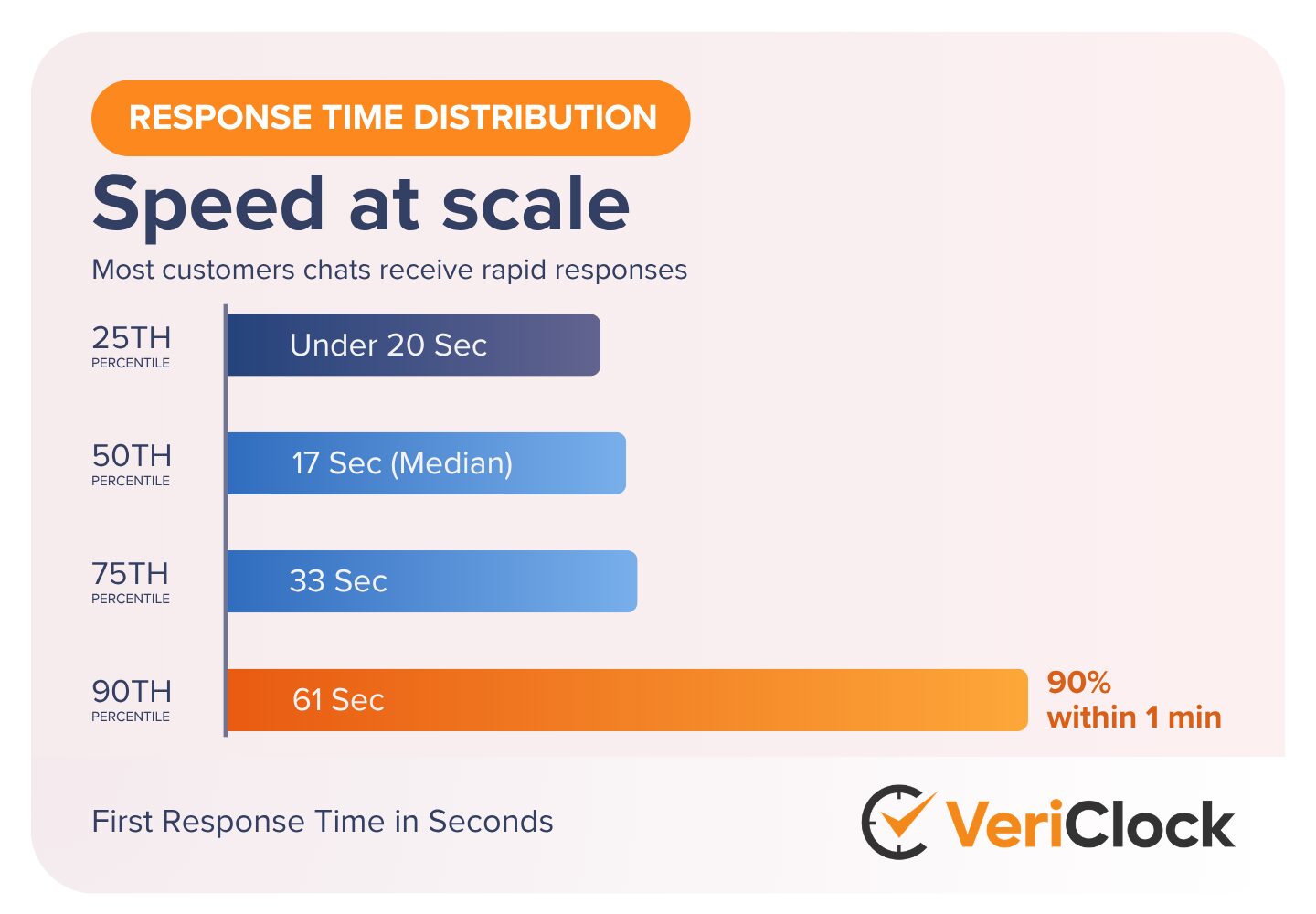
In 2025, VeriClock analyzed its internal support performance across thousands of customer interactions. The results:
| Percentile | Response Time |
|---|---|
| 25th Percentile | 17 seconds |
| 50th Percentile (Median) | 33 seconds |
| 75th Percentile | 52 seconds |
This means most customers receive a response in under a minute.
The Hidden Risk of Self-Service-Only Models
Research from Dartmouth Tuck School of Business shows that in high-stress situations, customers are less satisfied with self-service and prefer human interaction. This is especially true when deadlines are involved or financial outcomes are impacted.
Customers don’t want documentation—they want resolution.
VeriClock’s Approach: Support as Part of Payroll Integrity
At VeriClock, customer support is part of ensuring accurate time capture, structured approvals, and clean payroll exports. That means real human support, fast response times, and deep integration expertise.
Final Thought: If your current system leaves you waiting when it matters most, it’s not just a support issue—it’s a business risk.
Want to evaluate how your current system performs when it matters most? Book a demo and compare your support response time against real-world benchmarks.